Ovalo vs. Tuscola: Why the Average Home Price Won't Tell You What Either Town Actually Costs
August 27, 2026
August 27, 2026
Search "Ovalo TX home prices" and you will find two numbers for the same town, months apart, that do not agree with each other. Early in 2026, one market snapshot put Ovalo's average sold price at $183,465, based on a batch of just six recent closings. By July 2026, a separate source reported the average home price at $853,980. Same town. Same year. A nearly five-fold swing in a matter of months.
That gap is not a typo, and it is not two different Ovalos. It is what happens when you ask a market with almost no transactions to produce a statistic that behaves like a big-city median. If you are comparing Ovalo to its larger neighbor Tuscola, both sitting inside the Jim Ned CISD boundary and both marketed to buyers who want acreage without leaving the school district, the averages you see online will mislead you before you ever see a listing. Here is what is actually happening, and what to check instead.
Averages work when you have volume behind them. A market that closes a few hundred homes a year smooths out the outliers. A market that closes a handful of homes a year does not.
Ovalo is the second kind of market. When even one higher-priced acreage sale closes in a year where only five or six other properties change hands, that single sale can drag the "average" up by hundreds of thousands of dollars. Pull the data a few months later, after a couple of smaller resales close instead, and the average can just as easily collapse back down. Neither number is wrong. Both are honest snapshots of a market too thin to average in any meaningful way.
Tuscola does not have this problem, at least not to the same degree. It carries a median listing price of approximately $597,000 as of 2026, with 74 active listings and homes typically moving in around 35 days. That is still a small town by any standard, but it has enough transaction volume that a single unusual sale does not swing the headline number by half a million dollars.
| Ovalo | Tuscola | |
|---|---|---|
| Reported average home price (July 2026) | $853,980 | $633,849 |
| Alternate recent sold-price average | $183,465 (based on roughly 6 sales) | Not similarly volatile |
| Median listing price (2026) | Not stable enough to quote | Approximately $597,000 |
| Active listings | Thin, single digits to low dozens | 74 |
| Typical days on market | Not consistently reported | Around 35 |
| Land price per acre | Roughly $9,800 to $14,500, varying by which listings are counted | Comparable acreage sold under the same Jim Ned ISD draw |
The last row is the most telling. Land-listing aggregates for Ovalo do not even agree with themselves. One pull of the data shows an average of about $14,566 per acre across 84 parcels. A different pull, counting 78 parcels, shows about $9,830 per acre. The number of properties changed by six and the average per acre moved by nearly $5,000. That is not market movement. That is what a small denominator does to any average.
Texas A&M's Real Estate Research Center tracks this exact problem at the state level, and their language for it is useful here. Economists call it a composition effect. When sales volume in a market is low, the reported price can be propped up simply because a few high-quality tracts happen to close while ordinary properties sit unsold. The number looks like appreciation. It is really just which properties happened to sell.
The Center's most recent rural land report, covering sales through the first quarter of 2026, put the statewide price per acre at $5,246, up 6 percent year over year, while West Texas specifically came in at $2,947 per acre, up nearly 13 percent over the same period. Ovalo and Tuscola both trade well above that regional average, which makes sense given their proximity to Abilene and Dyess Air Force Base and the smaller, ranchette-style tracts that dominate listings there rather than large working ranches. But the same statistical caution applies at the neighborhood level as it does statewide: a handful of unusual sales can make a thin market look like it moved when it didn't.
If a market closes six homes a year, its average price is not a market signal. It is a coin flip that happened to land on whichever properties sold.
Tuscola's advantage is not that it is cheaper. Its median list price of roughly $597,000 sits above Ovalo's more stable land-based comparisons. Its advantage is predictability. With 74 active listings and a typical 35-day market cycle, a buyer or seller in Tuscola can look at recent closed comps and trust that they represent something close to current conditions. The town's draw is the same one pulling buyers toward Ovalo, land inside the Jim Ned CISD boundary, within a manageable commute of Abilene, but with enough turnover that pricing behaves the way pricing is supposed to behave.
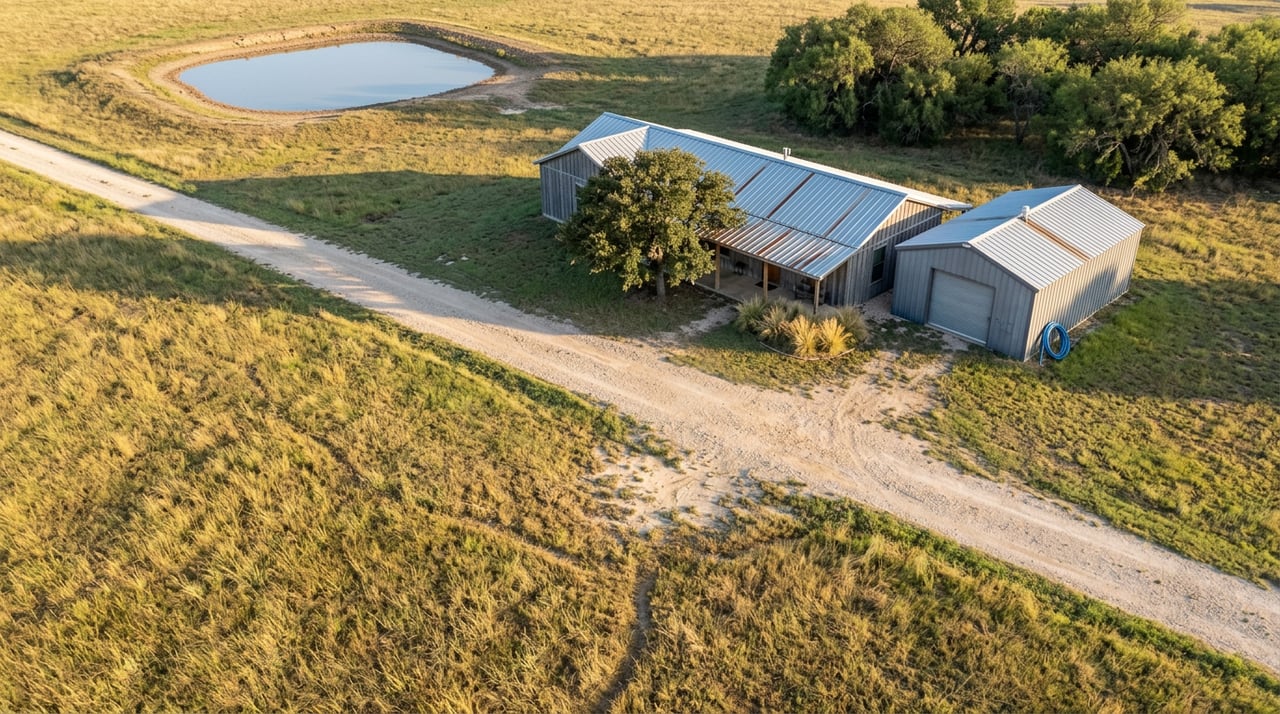
Ovalo's advantage shows up in the land, not the averages. Listings on both sides of the shared Jim Ned ISD land market make the case. Parcels along County Road 194 sit inside Ovalo itself, while comparable wooded acreage on County Road 206 falls just over the line in Tuscola, both marketed on the same acreage-and-school-district pitch. One active ranch listing sits directly on FM 614 in Ovalo. Another set of tracts is marketed just south of the historic Lemon's Gap landmark on US Highway 83, positioned a few miles from both Ovalo and Tuscola, and several nearby parcels near the small community of Bradshaw are flagged specifically for sitting inside Jim Ned ISD.
What this means in practice: if you are buying acreage rather than a finished home, Ovalo's per-acre pricing, somewhere in the $9,800 to $14,500 range depending on the parcel mix, gives you a more honest read on cost than any "average home price" ever will. A buyer comparing a 15-acre tract outside Ovalo to a similarly sized parcel closer to Tuscola should be pricing the land and the structure separately, not comparing town-wide averages that are being distorted by whichever handful of properties happened to close that quarter.
None of this means either market is soft. Rural land statewide has held up better than many expected, with prices resilient through 2025 and into 2026 despite elevated interest rates. Forecasters at an April 2026 Texas land markets conference in San Antonio pointed to mortgage rates potentially easing toward the 5 to 5.5 percent range by the end of 2026, which would matter more for financed acreage purchases than it does for the cash-heavy ranch transactions that sometimes distort these small-town averages in the first place.
The takeaway for a buyer choosing between Ovalo and Tuscola isn't that one town is objectively cheaper. It's that the averages you'll find with a quick search are not built to answer that question. The real comparison happens at the parcel level, with recent comps, actual acreage, and a clear-eyed look at how many sales are behind whatever number you're reading.
Does a lower reported average in Ovalo mean it's actually cheaper than Tuscola? Not reliably. Ovalo's averages swing so widely between sources, from roughly $183,000 to over $850,000 depending on which sales are counted, that the number tells you more about sample size than about actual cost. Comparing specific, similar properties is the only way to answer this honestly.
Does being inside Jim Ned CISD affect pricing on both sides of the two towns? Yes. Listings on both the Ovalo and Tuscola side of the district frequently cite the school boundary as a specific selling point, and properties confirmed to be inside Jim Ned ISD are marketed accordingly. Confirming a specific parcel's district status before comparing prices is worth the extra step, since boundary lines don't always follow town limits exactly.
Is now a good time to buy acreage in either market? Rural land prices have been resilient through 2025 and into 2026 even with borrowing costs elevated. If mortgage rates ease toward the 5 to 5.5 percent range by the end of 2026 as some forecasters expect, buyers already comparing specific properties, rather than waiting on the sidelines, will be better positioned to act.
If you're weighing acreage near Ovalo against a homesite closer to Tuscola, the fastest way past the conflicting averages is a side-by-side look at actual recent sales on the specific roads you're considering. Tiny or Grand Realty Group works both sides of the Jim Ned ISD line every week and can pull real comps, not town-wide guesses, so you know what a property is actually worth before you write an offer.
This article is general information, not legal, tax or financial advice. Consult a qualified professional about your situation.
Stay up to date on the latest real estate trends.
Explore our website to discover the latest property listings, insightful market reports, and valuable resources to empower your real estate decisions. Whether you’re a first-time homebuyer, seasoned investor, or looking to sell your property, Tiny or Grand Realty Group is here to make your real estate journey a seamless and rewarding experience. Thank you for considering Tiny or Grand Realty Group as your trusted real estate partner. Let’s turn your dreams into addresses!